
Last Updated: October 30, 2026
Quick Summary
To verify luxury furniture quality, inspect the frame, joinery, foam, and hardware yourself rather than trusting the price tag or label. Check for solid wood at load points, dovetail or mortise-and-tenon joints, dense foam that springs back, and solid metal hardware. Request material specs and provenance records for any vintage claim.
- Ask sellers to name the frame wood species and whether load-bearing parts are solid wood.
- Dovetail and mortise-and-tenon joints hold under load; staples, tacks, and glue alone signal a cheaper build.
- Press seat cushions firmly: quality foam springs back quickly when released.
- Quality drawer glides move smoothly and often include soft-close hardware.
- Request provenance documentation and treat any vintage claim as unverified until you can trace it.
Table of Contents
- Why Luxury Furniture Quality Demands a Closer Look
- Furniture Materials and Construction: What Separates Luxury From Mass Market
- How to Tell If a Sofa Is Well Made: Upholstery, Cushions, and Seams
- Inspecting Drawers, Glides, and Moving Parts
- How to Authenticate Vintage Designer Furniture
- Your Luxury Furniture Buying Checklist
- Shop With Confidence at House of Moseley
- Frequently Asked Questions
Why Luxury Furniture Quality Demands a Closer Look
Luxury furniture is generally built with materials, joinery, and finishing intended to hold up to daily use over many years. That definition matters because the price tag alone proves nothing. This guide explains how to verify luxury furniture quality with your own eyes and hands, so you can judge construction rather than rely on a label.
The stakes are higher than most shoppers realize. A mass-market sofa and a luxury sofa can look nearly identical in a photograph, then behave nothing alike after a few years of family life. The difference lives in the frame, the joints, the foam, and the fabric, and every one of those is inspectable before you buy. Below, we walk through exactly what to check, in the order we would check it ourselves.
Furniture Materials and Construction: What Separates Luxury From Mass Market
Luxury furniture is often distinguished by materials and construction methods that mass-market pieces may not use. Solid wood, true joinery, and quality hardware generally cost more to source and assemble. A useful approach is material verification: ask beyond whether a piece is "solid wood" and check the species, the veneer, the leather grade, and the metal content.
Furniture craftsmanship is not a marketing word. It describes decisions you can trace: which wood sits under the veneer, how the corners are joined, and whether the hardware is solid metal or plated pot metal. A common mistake is judging a piece by its surface finish alone, because the finish hides the structure beneath it.
Frames, Joinery, and the Hardware That Holds It Together
Start with the frame. A solid wood frame resists warping and holds screws and joints tight for decades; particleboard and MDF frames save money but crumble at stress points over time. Ask what species the frame uses and whether the load-bearing parts are solid or engineered wood.
Then examine the joinery. Wood joints tell you how much labor went into a piece. Dovetail and mortise-and-tenon joints interlock mechanically and hold under load. Staples, tacks, and glue alone signal a faster, cheaper build. Where you can see them, drawer joints are the easiest place to spot the difference.
Hardware finishes the picture. Quality drawer glides and hinges run smoothly, close quietly, and carry a name you can look up. Flimsy hardware is the first thing to fail on an otherwise decent piece.
Verifying Luxury Material Claims
Luxury materials are specific, and each has a verification method. For wood, ask for the species and whether the piece is solid or veneered. High-quality veneer over a stable substrate is a legitimate luxury technique, the tell is a thick, evenly matched veneer with consistent grain, not a paper-thin sheet that chips at the edges. For leather, ask whether it is full-grain, top-grain, or bonded; full-grain is the most durable and develops a patina, while bonded leather is a composite that peels. For stone, ask whether the top is solid stone or an engineered composite, and check for consistent veining and a sealed surface. For metal, ask whether legs and frames are solid brass, stainless steel, or plated; plated finishes wear through at contact points.
For a closer look at a finished piece, browse our Muuto sofa and ottoman in gray, a modular piece with clean lines and a sophisticated gray upholstery.

How to Tell If a Sofa Is Well Made: Upholstery, Cushions, and Seams
A well-made sofa combines a solid frame, dense seat foam, durable upholstery fabric, and tight, even stitching. You can evaluate all four in a showroom in about ten minutes with your hands and eyes.
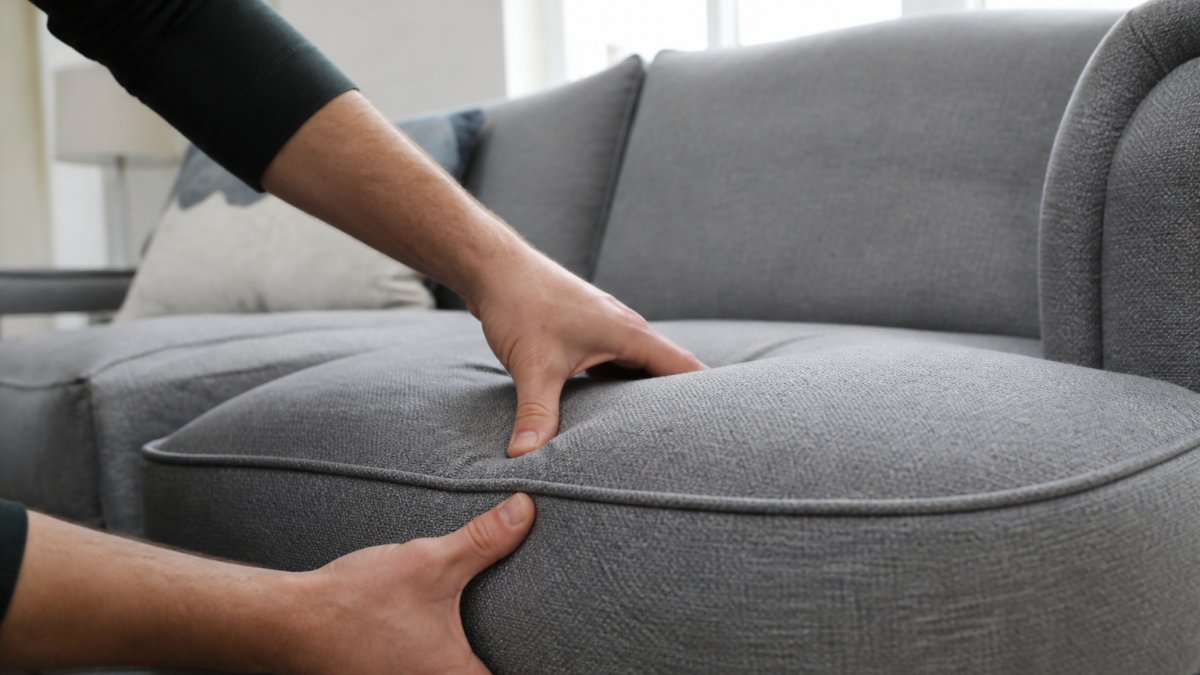
Press a seat cushion firmly and watch how it recovers. Quality seat foam springs back quickly when pressed. Removable cushions let you inspect the foam core directly, which is a real advantage over sealed cushions.
Run your hand along the seams. Even, tight stitching with no loose threads or puckering signals careful upholstery work. For a closer look at the kind of sofa that passes these tests, browse our Muuto sofa and ottoman in gray, a modular piece built for flexible, long-term living.
Testing Stability, Strength, and Wobble Before You Buy
Stability testing is simple: push gently on a corner and see whether the piece rocks, creaks, or shifts. A well-built frame stays planted. Lift one leg slightly and set it down; a solid frame settles without a shudder through the whole body. Sit on the edge of a sofa and listen for groans from the frame, not just the cushions.
Strength shows up in the details. Check that legs are attached with proper hardware and bracing, not just screws into soft wood. On larger pieces, confirm the structural integrity by looking for corner blocks or stretchers that reinforce the base. If a piece wobbles in the showroom, it will wobble worse in your home.
Inspecting Drawers, Glides, and Moving Parts
Drawers are where construction shortcuts hide in plain sight. Pull each one out fully and examine the drawer joints at the corners, the drawer glides on the sides, and the bottom panel that carries the weight.
Well-made drawers use dovetail or similar interlocking joints at the corners. The drawer bottom should sit in a groove rather than be stapled to the sides, because a grooved bottom holds weight without pulling loose. Test the glides by opening and closing the drawer several times: quality glides move smoothly and often include soft-close hardware. Cheap glides stick, grind, or let the drawer rack side to side.
Look inside the drawer. A pristine drawer interior with a smooth, finished surface suggests care in construction; rough, splintery interiors suggest the opposite. Our Adonis glam modern dresser with high-gloss white lacquer features six drawers, champagne gold accents, and is fully assembled.

How to Authenticate Vintage Designer Furniture
Authenticating vintage designer furniture means matching a piece to documented evidence: maker's marks, construction signatures, original hardware, and provenance records. A famous name on a listing is not proof of anything. A practical approach is to treat every designer or vintage claim as unverified until you can trace it through records, not just appearance.
Start with the maker's mark or label in the expected location, then compare the construction details to known examples of that design: the joinery, the hardware, the finish, and the proportions. An artificially distressed finish applied to new wood is a common red flag on pieces sold as antique.
Provenance documentation matters as much as the piece itself. Original receipts, auction records, maker catalogs, and estate inventories build a chain of ownership that supports authenticity. For guidance on which names carry real weight, read our overview of the best luxury home decor brands for modern homes.
For high-value pieces, an independent appraiser who specializes in the maker or era can confirm authenticity for a fee. Ask whether the appraiser inspects in person and provides a written opinion you can keep with the piece.
Your Luxury Furniture Buying Checklist
Use this checklist before you commit to any high-end piece. It compresses the inspection steps above into a sequence you can run in a showroom or during a remote walkthrough.
| Check | What to Look For | Red Flag |
|---|---|---|
| Frame material | Solid wood at load points | Particleboard or MDF frame |
| Joinery | Dovetail, mortise-and-tenon | Staples, tacks, glue only |
| Stability | No wobble or creak | Rocks or shifts when nudged |
| Seat foam | Springs back fast, dense feel | Stays compressed, feels thin |
| Upholstery seams | Even, tight stitching | Loose threads, mismatched pattern |
| Drawer joints | Interlocking corners | Stapled or nailed corners |
| Drawer glides | Smooth, soft-close | Sticking or grinding |
| Hardware | Solid metal, named brand | Plated pot metal |
| Finish | Even, smooth surface | Dents, bubbles, artificial distress |
| Documentation | Provenance and maker's marks | No records for a "vintage" claim |
- Confirm the frame species and solid-wood load points
- Inspect at least one visible joint on a drawer or frame corner
- Test stability by nudging corners and sitting on edges
- Press every seat cushion and check recovery
- Examine seams and stitching up close
- Open and close every drawer and door
- Request provenance documentation for any vintage claim
- Ask about care requirements for the specific material
When the checklist passes, you are ready to choose a piece. Our Revival coffee table has a curved wood top and iron legs.

Shop With Confidence at House of Moseley
Verifying quality takes effort, and that effort pays off every time you sit down or open a drawer for the next twenty years. The challenge is finding pieces that actually pass the inspection, which is where a curated selection saves you time.
At House Of Moseley, we offer a curated selection of hand-picked furniture and unique interior decor. Our collection also includes a curated wedding registry. If you are weighing whether the investment makes sense, our guide on whether luxury furniture is worth the higher price tag walks through the value argument in detail.
Explore House Of Moseley to find hand-picked furniture and decor for your home.
Frequently Asked Questions
How can you tell if furniture is high quality?
Start with the frame: solid wood or kiln-dried hardwood beats particleboard every time. Check the joinery for dovetail or mortise-and-tenon joints rather than staples and glue alone. Press on cushions to test foam density, look for tight, even stitching, and open every drawer to feel the glides. A luxury furniture piece will feel solid with no wobble, and the finish should be smooth with no visible dents or rough patches.
What should you inspect when buying luxury furniture?
Inspect the frame material and construction, joinery type, and hardware quality first. Then move to upholstery: check fabric durability, stitching, and seams for evenness. Open drawers to check glides and drawer bottoms. Finally, look for authenticity documentation and ask about the finish quality and any surface dents or visible damage before you commit.
How do you check furniture construction and joinery?
Look underneath and behind the piece. Dovetail joints on drawer fronts and mortise-and-tenon joints on frames signal craftsmanship. Staples and tacks alone are a red flag on structural joints. Check that glue is applied cleanly, not oozing. On upholstered pieces, lift a corner of the fabric if possible to see the frame. A solid wood frame with well-fitted wood joints will outlast one held together with staples and hardware alone.
How can you tell whether designer vintage furniture is authentic?
Authenticity starts with provenance documentation: original receipts, certificates, or maker's marks. Check for a stamped or branded signature in an inconspicuous spot, and compare hardware and joinery to known examples from that maker. An artificially distressed finish often looks uniform rather than naturally worn. A pristine drawer interior on a supposedly vintage piece is another red flag. Ask for the item's history and verify any labels against the maker's records before buying.
What questions should you ask before buying luxury furniture?
Ask what the frame is made of and how the joints are constructed. Ask about the cushion foam and fabric specifications. Ask whether the finish is hand-applied or sprayed, and whether the piece comes with authenticity or provenance documentation. For vintage pieces, ask about prior repairs and repairability. Finally, confirm the return policy and whether you can view the item in person before committing to a purchase.
