
Table of Contents
- Start With a Whole-Home Design Plan
- Choose One Interior Design Style, Then Bend It
- Whole House Color Palette Ideas That Hold Together
- How to Mix Interior Design Styles Without Clutter
- Use the 70/30 Rule in Decorating to Balance Variety
- Create Room-to-Room Flow With Repetition and Sightlines
- Fix the Cohesion Mistakes That Undo a Good Plan
- Frequently Asked Questions
Last Updated: October 19, 2026
Start With a Whole-Home Design Plan
A cohesive home starts with a single document, not a single room: your whole-home design plan, which decides what each space will look like before you buy anything. Rooms decorated one at a time drift apart. Write the plan down first.
The plan does three jobs:
- Sets one interior design scheme for the whole house
- Lists the rooms in priority order
- Records the colors, materials, and finishes you have committed to
The Room-by-Room Planning Worksheet
Fill this in before you shop. It takes about an hour and saves months of returns.
| Room | Main Use | Style Note | Anchor Color | Key Material | Priority |
|---|---|---|---|---|---|
| Living room | Gather, relax | Calm, warm | Warm cream | Oak, linen | 1 |
| Dining room | Host, eat | Slightly formal | Warm cream | Oak, brass | 2 |
| Primary bedroom | Rest | Quiet, soft | Soft gray | Wool, cotton | 3 |
| Entry | First impression | Bold accent | Deep green | Stone, brass | 4 |
Keep one copy on your phone. Every purchase gets checked against it.
Choose One Interior Design Style, Then Bend It
Pick one interior design style as your base, then allow small departures inside it. A single style gives the eye something to hold onto; bending it keeps the house from looking like a showroom catalog.
Name the style in plain words. "Warm modern with traditional touches" is usable. "I like everything" is not.
Next, set your bend rules. Write two or three:
- Wood tones stay in the warm range, no cool gray stains
- Metal finishes are brass or bronze, not chrome
- Patterns stay small and quiet, with one bold exception per room
Those rules do the heavy lifting later: when a piece does not fit, they tell you to walk away.
Whole House Color Palette Ideas That Hold Together
A whole house color palette works when it has one foundation color, two supporting colors, and one accent. Everything else is variation.
Build a Color Foundation in Three Layers
Layer one: the foundation. This is your wall color and your largest surfaces.
Layer two: the supporting colors. Choose two colors that sit next to the foundation on a paint deck.
Layer three: the accent. One stronger color, used in small doses. A deep green, a rust, or a navy.
Then vary the strength, not the color. The living room can carry more accent than the bedroom.
For deeper guidance on color in interiors, the basics of color theory from the Smithsonian's design resources are a solid starting point.
How to Mix Interior Design Styles Without Clutter
Mixing styles works when one style clearly leads and the others follow; the moment two compete as equals, a room reads as clutter. Decide the lead style first, then bring in the second at roughly 80 percent lead, 20 percent second, two pieces out of ten visible elements.
Try these pairings:
- Traditional lead with a few modern pieces
- Modern lead with one antique wood piece
- Coastal lead with one industrial metal accent
Keep the second style in one material or one shape family. Two modern chairs, not modern everything.
The Three Mistakes That Turn Mixing Into Clutter
Most style-mixing failures come from three habits. Each has a fix you can apply without starting over.
Mistake one: two styles at equal strength. A mid-century sofa across from a farmhouse hutch, neither leading, splits the room in half.
Mistake two: mixing more than two styles. Three styles in one room is almost always one too many.
Mistake three: matching the second style too literally. A single industrial accent works; an industrial light, shelving, and hardware together read as a theme room.
A Troubleshooting Checklist for a Room That Feels Off
When a mixed room feels disconnected but you cannot name why, check these:
Volume: Let Europe's Finest Style Experts Spice up Your Home →
- Is there a clear lead? Mentally remove the second-style pieces. If the room still looks complete, the lead is working; if it looks empty, the second style carries too much.
- Do the wood tones agree? Mixed warm and cool wood is the fastest way to break a mixed-style room. Keep every wood in one family.
- Is the metal finish consistent? Two metal finishes in a room is fine; three is noise. Pick two and repeat them.
- Does the second style appear at more than one scale? One large and one small piece is the right dose; five small pieces is clutter.
- Would the room work without the second style? If yes, the mix is additive rather than essential, which is exactly what you want.
Rental-Friendly and Reversible Mixing
Renters can mix styles without permanent commitments. Keep the lead style in pieces you own, sofa, rug, bed, and bring the second style in through removable wallpaper, swap-out lamp shades, framed art, and throw pillows. The 80/20 split still applies; only the materials change.
Use the 70/30 Rule in Decorating to Balance Variety
The 70/30 rule in decorating splits every room into a dominant look and a supporting one: seventy percent follows your main scheme, thirty percent brings contrast, texture, or a different era. That ratio is why some rooms feel calm and others busy, 50/50 has no clear lead, 95/5 feels flat.
Apply it to:
- Color: 70 percent foundation and support, 30 percent accent
- Texture: 70 percent smooth surfaces, 30 percent rough or woven
- Style: 70 percent lead style, 30 percent second style
- Pattern: 70 percent solid, 30 percent pattern
A Worked Example You Can Copy
Take a living room with ten visible elements: a sofa, two chairs, a coffee table, a rug, two lamps, a side table, a large artwork, and a throw. Seven follow the lead scheme, sofa, chairs, coffee table, rug, both lamps, side table in warm-neutral oak and linen, while the artwork, throw, and one chair cushion carry the accent color and second style.
Where the Ratio Breaks Down
The 70/30 rule is a starting point, not a building code. Three situations call for bending it:
- Small rooms. In a compact room, 80/20 reads calmer because there are fewer elements competing for attention. Save the stronger 30 percent contrast for the largest room in the house.
- Open-plan spaces. When two rooms share one sightline, treat the combined view as a single composition. The 70/30 split applies to the whole view, not to each zone separately.
- Rooms with a strong architectural feature. A stone fireplace or a wall of windows already supplies contrast. Drop the decorative 30 percent to 20 percent so the architecture stays the focal point.
Budget-Conscious Prioritization
The 70/30 rule also tells you where to spend. Put your budget into the 70 percent, the sofa, rug, dining table, the pieces you see and touch daily, and save on the 30 percent: a thrifted artwork, a clearance throw, a single accent chair.
If you are furnishing over time, buy the 70 percent first. A room with a solid foundation and no accent still reads as cohesive; a room with bold accents and no foundation reads as scattered.
Create Room-to-Room Flow With Repetition and Sightlines
Visual continuity comes from repeating a few elements and protecting the views between rooms. Repetition tells the eye the spaces belong together.
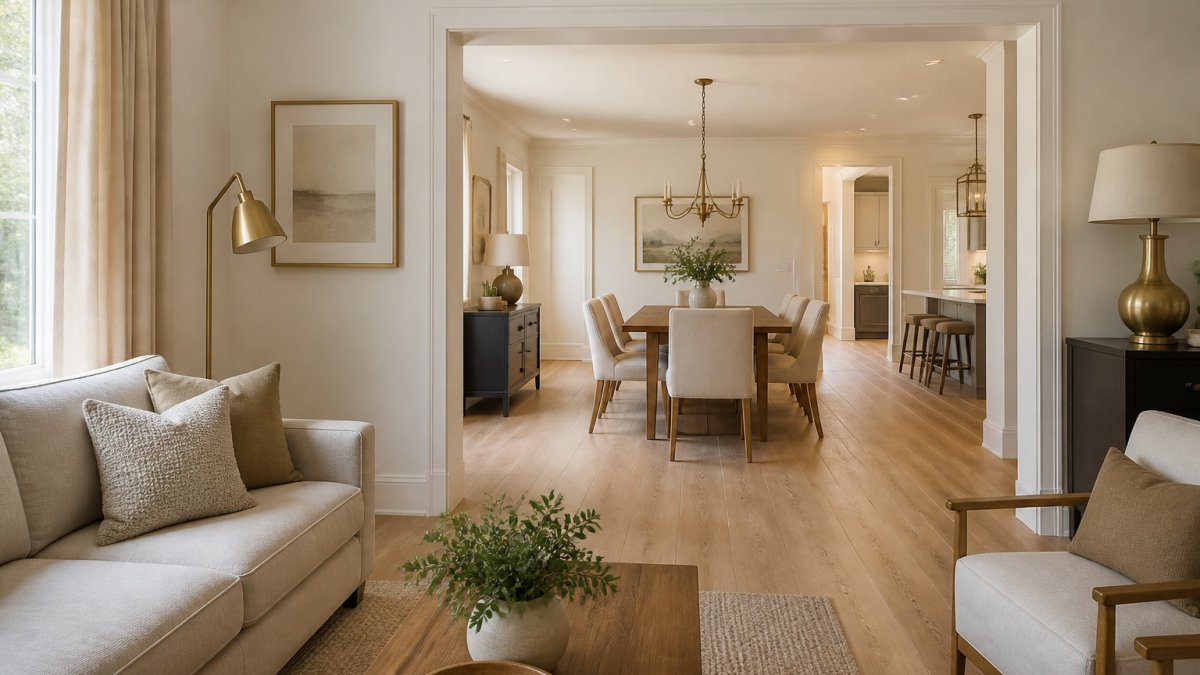
Stand in each doorway: whatever you see should share something with the room you are in, a rug color, a wood tone, the same metal finish.
In an open-plan space the whole view is one composition, so repetition must carry across the full sightline.
Repeat Materials, Finishes, and Wood Tones
Choose three materials and repeat them in every room. A common set:
- Warm oak for wood
- Linen or wool for fabric
- Brass for metal
Then repeat them at different scales. Oak as a floor in one room, a side table in the next, a frame in the third. Same material, new role.
Wood tones need the most care. Keep every wood in the house within one warm or cool family. Mixed families are the fastest way to break room-to-room flow.
Fix the Cohesion Mistakes That Undo a Good Plan
Most cohesion problems come from four habits. Each has a quick fix.
| Mistake | Why It Breaks Cohesion | Fix |
|---|---|---|
| Buying room by room with no plan | Rooms drift into different schemes | Write the worksheet first |
| Mixing warm and cool wood tones | The eye reads the mismatch instantly | Pick one wood family house-wide |
| Matching everything exactly | The house feels flat and staged | Add 30 percent contrast |
| Ignoring sightlines from doorways | Rooms look disconnected in view | Check each doorway view |
Rentals and small homes need a lighter version: keep the palette and materials fixed, and change only what you can reverse, rugs, art, lamps, removable wallpaper.
If you want a designer's eye on color and material choices, the American Society of Interior Designers' consumer resources explain how professionals build a scheme. And for anyone planning a renovation, the U.S. Department of Energy's home design guidance covers layout and light before finishes.

When you are ready to source pieces that fit the plan rather than fight it, our curated furniture collection at House Of Moseley is built around hand-picked, high-quality pieces. Our book, Volume: Let Europe's Finest Style Experts Spice up Your Home, gathers insider guidance on color, materials, and storytelling in interiors.

A cohesive home is not about matching everything.
House Of Moseley can help you build that plan with hand-picked furniture, unique decor, and a curated wedding registry for couples furnishing a first home together.
Frequently Asked Questions
What is the 70/30 rule in decorating?
The 70/30 rule splits each room into a dominant look and a supporting one. About 70% of what you see follows one direction: the wall color, the main upholstery, the largest rug. The remaining 30% brings contrast through a second style, a bolder pattern, or a different material. In a cohesive home, keep the 70% consistent from room to room and let the 30% shift. That way each space feels related but not copied, and a collected room never tips into visual noise.
How do you make different rooms flow together?
Pick three elements and repeat them in every room: one wood tone, one metal finish, and one color. Then check your sightlines. Stand in your main doorway and look into the next space. If the flooring changes abruptly or the wall color jumps, the eye registers a stop. Carry the same flooring or a closely related tone through connected rooms, and repeat a material like rattan, brass, or walnut at least twice per space. Repetition is what turns separate rooms into a cohesive home.
How do you create a cohesive look in an open-plan space?
Treat an open-plan space as one room with zones, not several rooms sharing a wall. Use a single wall color and one flooring throughout, then define each zone with rugs, lighting, and furniture placement rather than color changes. Keep the largest pieces, like the sofa and dining table, in the same wood or finish family. Use the 70/30 rule across the whole footprint so the living area and dining area share a dominant look while each zone gets its own 30% of contrast.
How do I keep a cohesive home when I rent or have a tight budget?
Start with what you can reverse. Removable wallpaper, large rugs, and freestanding furniture do most of the cohesion work without touching the walls. Prioritize the pieces the eye lands on first: the rug, the main seating, and the lighting. A $30 design book is also a cheap way to settle on a direction before you spend on furniture, and it gives you a reference to shop against. Spend on the anchor pieces and save on accessories, which are the easiest to swap later.